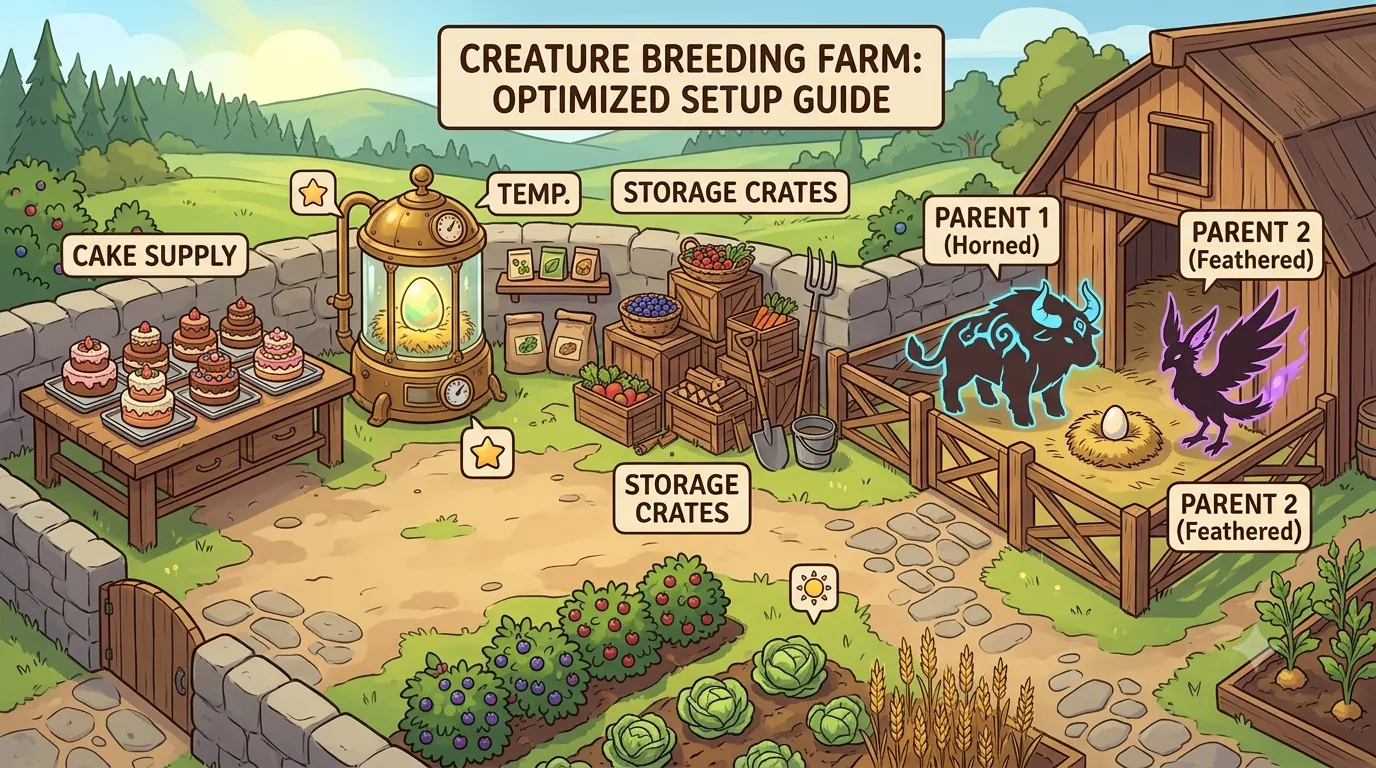
Keep each ingredient available before assigning parents, because the Breeding Farm cannot turn a valid parent pair into steady eggs without Cake supply.
Question Guide
How many Cakes do you need for breeding in Palworld?
Plan Cake as a repeatable supply, not a one-time item: each serious breeding project should begin with enough Cake production to support multiple eggs and failed passive rolls.
Next step
Use this Cake loop before the breeding calculator so parent routes do not stall after the first egg.
Guide notes
This page avoids hard inventory-count promises and instead teaches players how to size Cake supply by breeding goal, route confidence, and passive-hunting risk.
Cake breeding supply loop
Open breeding calculatorTreat Cake as a base workflow: ingredient production, cooking throughput, storage placement, and Breeding Farm access all affect route speed.
Simple target breeding can start with a small reserve, but passive projects need batch thinking because failed rolls consume time and Cake.
How to use this answer
Treat the direct answer above as the decision point, then follow the linked guides when the mechanic turns into a route, base setup, or material farm. Palworld 1.0 changed enough systems that old shortcuts should be checked before they become a long breeding or crafting session.
Next check
- Open the related Pal, resource, or base guide if the answer mentions a specific target.
- Use the breeding calculator when the question becomes a parent-pair decision.
- Use the material calculator when the question becomes a material-chain decision.
Decision checkpoint
breeding routeIf this answer changes what you do next, turn it into a concrete breeding route before leaving the page. For breeding decisions, the most relevant Pal checks are Yakumo, Anubis.
For material planning, check Flame Organ before committing to the route.This extra check matters because many Palworld questions sound like simple mechanics, but the actual time loss usually comes from the next route being underprepared.
Common failure mode
Before you actThe most common mistake after reading a short mechanic answer is stopping before the next dependency is ready. Check Yakumo, Anubis before committing to a breeding route.The answer is useful when it changes the next action, not when it remains a fact disconnected from the player's current bottleneck.
Confirm the dependency
Before turning this answer into a long session, name the dependency that would stop the plan: a parent Pal, Cake supply, egg handling, unlock currency, farming material, base slot, or worker role. That dependency tells you which linked guide deserves attention first.
Stop when the route changes
If the answer sends you toward a different target than expected, stop and re-plan instead of continuing with the old checklist. Palworld routes are connected enough that one wrong assumption can waste captures, materials, incubation time, or base work.
Size Cake by project type
A single child route needs less Cake than a passive-hunting project. If you only need the Pal once, prepare enough Cake to test the route and hatch a backup egg. If you are chasing passives, assume repeated eggs are part of the plan.
Do not start with an empty pantry
Cake ingredients should be ready before the parents are assigned. Starting the breeding loop first and solving Cake later creates idle farm time, awkward base trips, and extra chances to forget which route you were testing.
Track failed rolls as expected cost
Failed passive rolls are not wasted information if you planned for them. Keep notes on which parents produced useful children, then use the results to decide whether the next Cake should go into the same pair or a cleaner parent setup.
Quick checklist
- Decide whether the goal is one child or passive farming
- Prepare Cake ingredients before assigning parents
- Keep notes on each route tested
- Stop and re-plan if Cake runs out before useful results appear
Related breeding guides
NeutralYakumo
Yakumo is valuable in Palworld 1.0 because players use it when planning passives and hunting stronger trait outcomes through breeding and encounters.
GroundAnubisAnubis is still a top target for breeding because of its handiwork value and combat utility, but Palworld 1.0 changed enough breeding data that older Penking + Bushi style routes should not be reused blindly.
Related resources
Related base guides
Sources used
Source policycommunityThe Palworld Wiki - Breeding
Used for the basic breeding requirements: Breeding Farm, one male and one female Pal, Cake, egg collection, and incubation.
communityShockbyte - Palworld Breeding GuideUsed for Cake recipe, breeding setup, step-by-step process, 1.0 specialist cakes, and Anubis route guidance.
communityReddit r/Palworld - 1.0 breeding rank changes discussionUsed as a community datamine reference for 1.0 breeding rank changes, tower boss same-species breeding, mutation rates, and Special Cake passive inheritance discussion.